Recently I’ve been thinking about what change management might look like for wicked problems. I think the first thing to say is that ‘management’ is probably the wrong word because it tends to convey a sense of straightforward causality. I manage well and that directly leads to something specific improving in my context. Wicked problems by definition are those where attempts to address the problem generate unforeseen outcomes. Wicked problems are also challenges that bring together competing world views and frames of reference. Wicked problems are highly complex, they interact with one another, and the problem space is often unclear. All of this being the case, there’s a very low chance that change could be managed in any linear, or directly causal, or easily measurable manner.
I’m also quite influenced by sociocultural (for example) and sociomaterial perspectives (for example) on wicked problems. In these perspectives, there are many change agents and they are not all human. The outcomes of any interaction with a wicked problem emerge in relation to the histories of past attempts on the problem and the histories of the protagonists. They are also shaped by the popular stories floating about in our social worlds such as ‘technology will make things cheaper and simpler in our context’. Then there are the languages available in the problem space, think ‘injured children’ vs ‘collateral damage’. In our contemporary world, algorithms are social actors in their own right, as are many other aspects of digital technologies. In the midst of an ecological meta-crisis, we’d be remiss to forget that non-human animals and ecosystems are actors: mosquitos anyone?
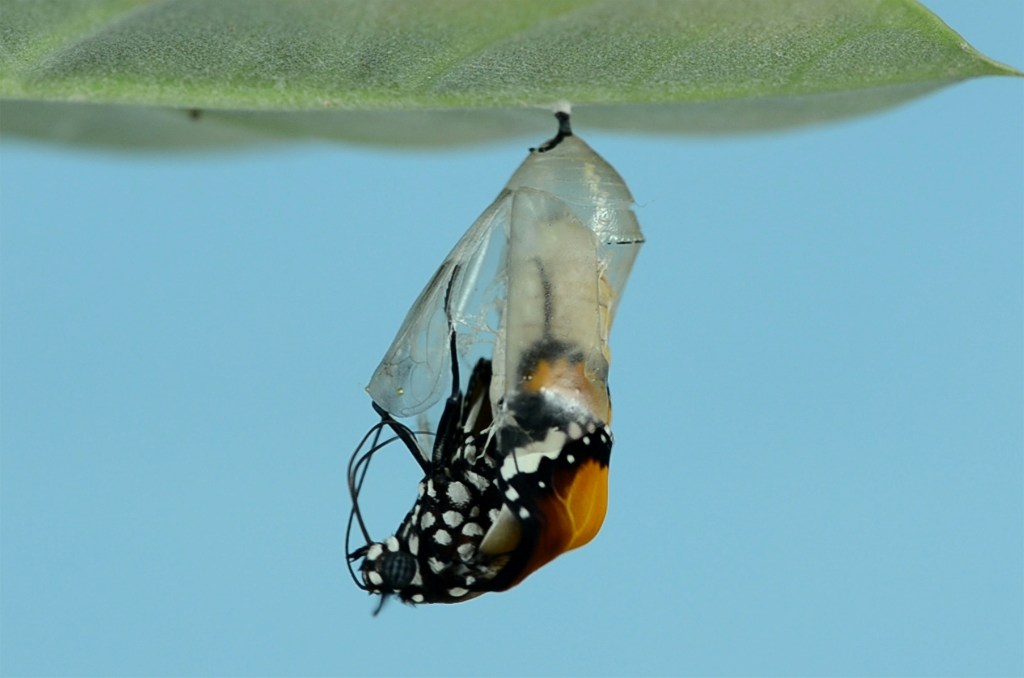
So, I think a better description of how we work with wicked problems might be something like ongoing improvisation with what’s emerging from all of this complexity. That makes it very important that our approaches don’t close down unexpected but potentially fruitful emergence. If we can only imagine neoliberal technofutures, then we may not see the butterfly of a better way emerging from her chrysalis and we might step on her. (OK too many metaphors now 😊). We also need to be very careful with our indicators of progress. It’s unlikely anything we can measure will capture complex emergence well and it’s easy to harm a butterfly if we expect it to behave like a spider and judge it for fluttering about.
Attention to our inner ways of being needs more consideration in responses to wicked problems. Most human beings do not like uncertainty and risk so we need to be mindful of what arises within us as new futures emerge. Compassion is an under-rated quality in contemporary societies. We’re all experiencing a world that’s never been experienced before and perhaps one that’s never been so fast moving or complex. So, it’s not really surprising that none of us entirely know what we’re doing and we’re all freaking out a bit! Contemplative practices, humility, openness, and courage need to come to the fore. When we don’t know what’s coming, we can’t be sure which perspectives we will need most, so openness to the gifts of diverse ways of knowing and being has never been more important.
At this point I suspect some readers will think I’m being a bit fluffy, if you’ve not already given up reading this 😊 I’m not suggesting an easy, soft anything goes approach at all though. As we work with emergence we all need to be strong enough not to retreat into cynicism or under the duvet and instead ask ourselves hard questions:
- How does who we are and where we’ve come from affect how we are responding to what is arising?
- Whose voices are valued as we consider next steps and whose are silenced?
- What are we not seeing because of who we are?
- How hospitable is our collaboration, to what extent are all participants welcome as they are?
- What kinds of boundary spaces are we working in and where are we likely to get our communicative wires crossed because we have different assumptions and languages?
- What imagined futures are available here and what is being closed down?
- Are we trying to pour from empty cups because we need to show off how busy we are? Who does that actually benefit?
- Who are all the human and non-human beings we depend on? Have we considered them all and are we thankful?
Photo by Bankim Desai on Unsplash
 wickededucation.blog
Leave a comment