This morning I was talking with some of my colleagues from the Academic Hospitality in Interdisciplinary Education Project. We were trying to work out what some of the common threads are in the papers we’ve been developing for the Society for Research in Higher Education Conference. We talked about the distributed leadership and agency that goes on in order to make interdisciplinary education work in an hospitable way, often despite institutional structures and funding constraints that make this work difficult. When I write ‘hospitable’ here I mean the ethics and practice of welcoming everyone who comes to interdisciplinary education just as they are, without imposing conditions. There’s more about that in this previous post.
To make interdisciplinary education happen, academic and professional services staff from diverse disciplines and backgrounds have to welcome new ways of thinking, new values and new practices. They need to form positive relationships and collaborations that carry forward work that may not fit well with existing policy and practice and that usually takes much more time than any workload allocation model would acknowledge. Then they need to find the emotional energy to keep welcoming students from a wide range of disciplines and backgrounds and truly hear and value the diversity of their contributions.
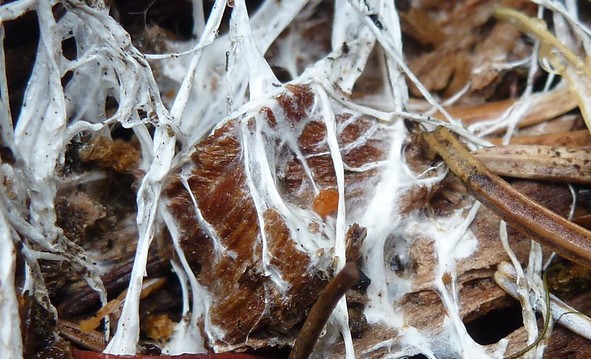
We talked about the ways in which there seemed to be networks or webs of hospitable relations underpinning interdisciplinary education, which interacted with -but were often separate from – formal structures and governance. We could see how meaningful and creative this work was for our participants but also how much strain it put on them. I was trying out the metaphor of a spider web for this but my colleagues reminded me that spider webs are tremendously strong and have a predator in the middle of them 🙂 So I started playing with the metaphor of mycelial networks instead. These are symbiotic, messy and complex networks of delicate connections that are essential for life on earth. I think that’s a better metaphor … what do you think?
Image by Laurel F on Flickr https://creativecommons.org/licenses/by-sa/2.0/ edited by Vel McCune
 wickededucation.blog
Leave a comment