
This week I’ve been doing some reading about assessment rubrics as part of my academic development role. Assessment rubrics are boundary objects that set out the criteria for assessments and describe what different levels of performance look like (see e.g. Reddy and Andrade, 2010). They can be very detailed tables or more open descriptions. There are lots of examples available online. I think rubrics are interesting in relation to the assessment of courses about wicked problems as they can be part of the solution to the misunderstandings that tend to arise between students and teachers about what makes for high quality academic work.
Even for quite straightforward topics, there is lots of evidence that teachers and students struggle to achieve shared understanding of assessment expectations (there’s lots of literature about this, including Sadler, 2010). This is partly because language is inherently ambiguous and you need to be familiar with the social world it relates to in order to be able to understand it (Rommetveit, 1974). For example, a history academic telling a student they need ‘make better use of evidence to support their arguments’ means something quite different from a psychology academic using the same words. Both ‘evidence’ and ‘argument’ mean something a bit different within the cultures of different academic disciplines. A related issue is that students bring understanding from their prior learning contexts and interpret new guidance about assessment through that lens, which can also lead to crossed wires (McCune, 2004)
All of this is magnified for assessments that relate to wicked problems. These assessments tend to ask students to work across boundaries between academic disciplines and between the academy and the wider world. This opens up more potential for miscommunication due to having different socially constructed understandings of key language. Assessments relating to wicked problems also tend to consider more subjective achievements, such as openess to diverse world views or cultural sensitivity. These do not lend themselves to easy ‘transparent’ communication.
I’ve put ‘transparent’ in quotations as I don’t think it’s actually possible. Working towards enough mutally shared understanding to be able to work together is a more realistic ideal. Rubrics may be able to help with all of this if we use them in the right way. I think this involves:
- realising that rubrics are boundary objects that need to be sufficiently flexible that they can make sense within different communities while having enough common ground that they help coordinate thinking;
- treating assessment rubrics as a tool for communication rather than something that can simply be handed to students as a ‘transparent’ explanation;
- helping our students understand that complete transparency and objectivity are not reasonable goals in relation to assessing complex capabilities;
- realising that we also need to use the rubrics to coordinate understanding between markers, it’s pretty unlikely that the whole of an interdisciplinary marking team will be on the same page to start with;
- considering our use of rubrics as part of the whole assessment and feedback cycle, as in the diagram below;
- ideally co-creating our rubrics with our students.
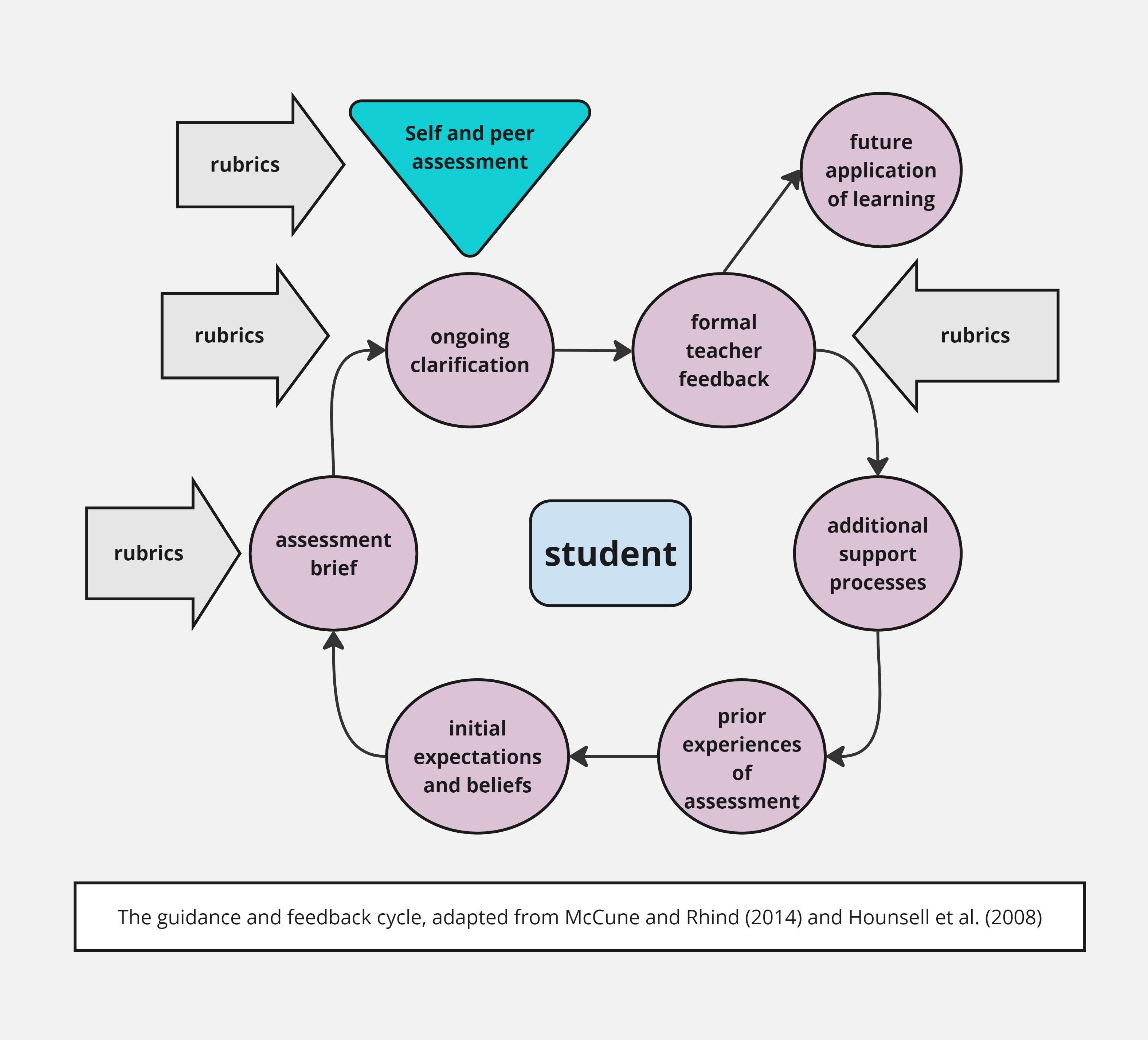
Photo by Kenny Eliason on Unsplash edited by Vel McCune
 wickededucation.blog
Leave a comment